
Inside: Discover the fascinating world of thixotropic liquids. From heather honey to ketchup to gelatin, learn how these materials change viscosity when agitated. Above: Grapefruit flowers produce nectar that is moderately thixotropic, a property that varies with the variety. Florida, California, and Texas lead U.S. production of grapefruit.
Table of contents
- Newtonian vs non-Newtonian fluids
- The secret in the sauce
- The opposite of thixotropy
- Thixotropic honey varieties
- Pressing honey with a wax screw press
- Extractors and thixotropic honey
- Using a tangential extractor with gelled honey
- Is your honey thixotropic or crystallized?
- Be sure to try some thixotropic honey
- Notes and references
Here’s a quiz: What do ketchup, yogurt, gelatin, and heather honey have in common? You got it! They are all thixotropic liquids. Thixotropic materials are thick and viscous when motionless but become thinner when agitated.
At my home, we always keep a humongous bottle of ketchup on the kitchen counter. After sitting untouched for several days, you can invert the bottle over your plate and nothing happens. The thick red glob remains pasted to the bottom as your fries get cold. But shake it hard, or give the bottom a sharp rap, and the ketchup will flow like thick syrup. Depending on the recipe, some brands will continue to flow for several hours, others for only minutes before you need to shake them again.
Newtonian vs non-Newtonian fluids
Ketchup is called a non-Newtonian fluid because its viscosity depends on the amount of shear stress applied to it.1 This is not “normal” behavior. Most liquids are called Newtonian fluids and behave more like water.
Most Newtonian fluids like soy sauce, grape juice, or a cold brew do not need to be encouraged out of their container. Turn them over and gravity does all the work. If you add pressure, they flow faster (think of water in a garden hose), but they do not change consistency: Water standing in a pool is just as liquid as water from a faucet. However, the viscosity of Newtonian fluids is strongly dependent on temperature, with colder fluids being more viscous than warm ones.
But in undisturbed thixotropic fluids like ketchup, neighboring molecules form weak bonds with each other. These may be hydrogen bonds, van der Waals bonds, or even electrostatic bonds that hold the ketchup together in a gelatinous state. The bonds form over time as long as the fluid remains motionless. But once we break those bonds by shaking or stirring, the flow returns, covering your fries with tomatoey goodness.
The secret in the sauce
To get a thixotropic liquid, something must be present in the mix that encourages weak bonds to form. In food items, it is often a type of protein or other complex molecule such as dextran.2 If one or more of these substances is present, the gel forms. The reaction may be fairly quick or it may take days, depending on a variety of factors.
Non-food items can be thixotropic, too. For example, paint, shampoo, and blood are all thixotropic. Synovial fluid, the lubricant that reduces friction between the bones in our joints, gels at night as we sleep. But as soon as we begin to move our joints the next morning, it quickly reverts to a thin liquid.
The opposite of thixotropy
Much less common is a second type of non-Newtonian fluid that does the opposite. Liquids that get stiffer with agitation are called anti-thixotropic or rheopectic. A common example is inkjet printer ink, which starts as a liquid but gets stiffer as it goes through the printer jets. This thickening allows the ink to dry quickly before it smudges the next sheet.
Another memorable example of rheopecty is Silly Putty.3 Silly Putty does many cool things, including bouncing, stretching, and tearing. Strong bonds hold the polymer together, but weaker bonds form between the molecules. Breaking the weak bonds at different rates produces the unique characteristics kids love. But leave Silly Putty undisturbed long enough and it will puddle like a liquid. Since 1950, parents have warned their children to store the putty in its egg to keep it from melting into the carpet (although many of us failed).4
Thixotropic honey varieties
Some of the most famous honey varietals in the world are highly thixotropic, a characteristic usually attributed to the presence of a certain protein in the nectar collected by the bees. These types of honey can be vexing for beekeepers because the honey won’t easily flow out of the cells, even in a radial extractor. Fortunately, most honey has only small amounts of protein and behaves like a normal Newtonian fluid.5
Because beekeepers are enterprising folks, those with lots of thixotropic honey have clever ways of dealing with it. Many of the extraction techniques, which tend toward messy and time-consuming, were developed in Europe, Australia, and New Zealand where varieties of thixotropic honey are much more common than in North America.
The most famous varieties of thixotropic honey include:
- Manuka honey, known for its medicinal qualities, comes from the nectar of Leptospermum scoparium, a tree native to New Zealand and Australia. Of all the thixotropic honey varietals, it holds the record for the speed at which it resumes the gelled state after agitation.
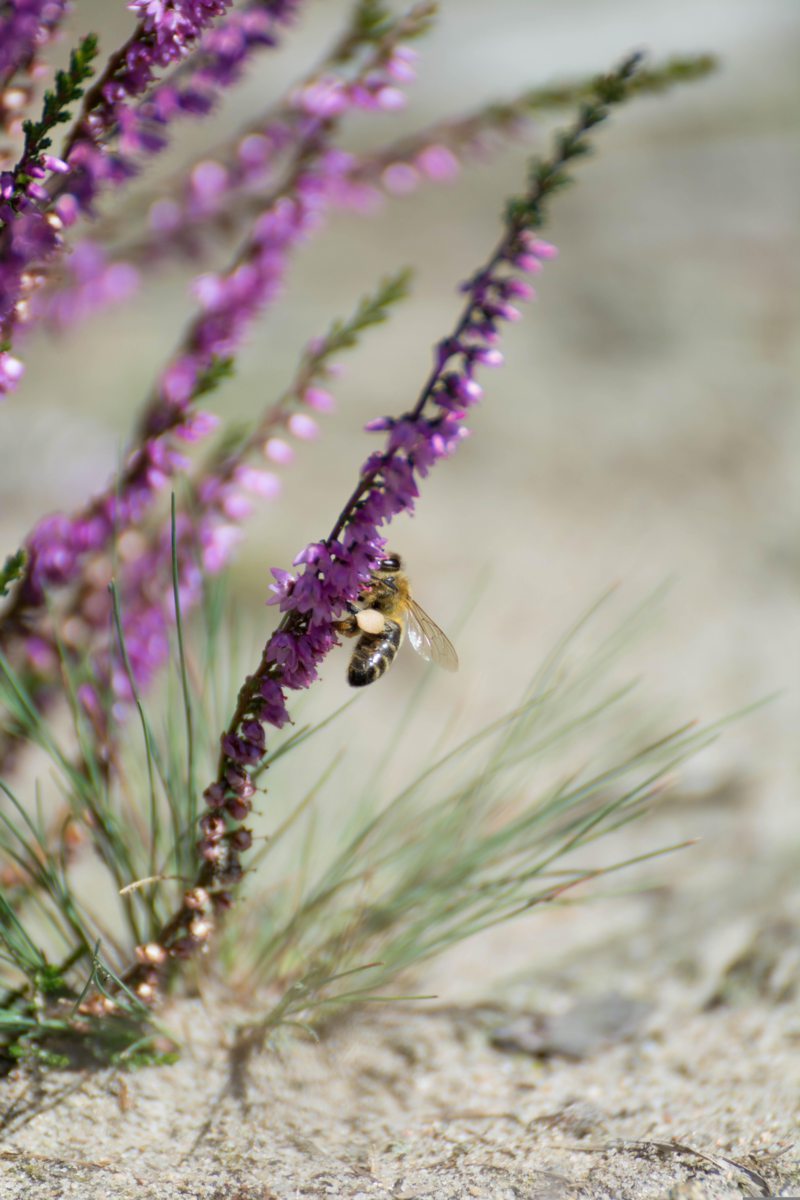
- Ling (or common) heather honey, made from the nectar of the heather plant, Calluna vulgaris, is famously thick, strongly flavored, and dark colored. Common in Europe, heather honey spurred much of the experimentation into alternative extraction methods.6
- Eucalyptus (Eucalytus spp) honey is the product of various species of eucalyptus trees that grow in Australia. Eucalyptus honey comes in a treasure trove of colors and has a wide range of thixotropic properties that vary from species to species. However, a few species of eucalyptus display no thixotropy at all.7
- Buckwheat honey derives from the nectar of buckwheat, Fagopyrum esculentum. Buckwheat honey has a memorable dark brown color and a strong, molasses-like flavor. Its thixotropic properties vary, probably as a result of the nectars mixed with it.
- Grapefruit honey comes from the nectar of grapefruit blossoms, Citrus paradisi. It ranges from light to dark amber and is moderately thixotropic.
The easiest way to sell thixotropic honey is in the comb. When eaten in the comb, the gel breaks down when the honey is spread onto toast or crackers, making it behave like any other comb honey. But if you must extract your crop, beekeepers have devised ways to do it.

Pressing honey with a wax screw press
Many beekeepers simply press the honey out of the combs. Unfortunately, pressing destroys the comb, but with thixotropic honey, even pressing won’t separate the honey from the beeswax. Gravity doesn’t help much, so an extra step must follow.
Some beekeepers like to use a wax screw press, a device with a large screw in the center of a cylinder, kind of like a meat grinder. But the cylinder has slits along its length that exude liquid honey as it separates from the wax. The honey collects in a sump below the cylinder and dry wax curls drop from the end.
Before going into a jar, the honey must be strained, a process that takes a long time. Because it is so stiff and thick, it requires constant stirring so the honey doesn’t jam the strainer and form a gel around the wax pieces.
Extractors and thixotropic honey
Another way to extract requires a tangential extractor instead of a regular radial extractor. Radial extractors hold the frames perpendicular to the side of the extractor like the spokes of a wheel, while tangential extractors hold the face of the frame parallel to the side of the extractor. Each type has pros and cons.
For example, radial extractors spin faster, but tangential extractors can extract larger frames without damaging the combs. However, because the tangential type extracts only one side at a time, the beekeeper must flip the frames after the first side empties. To address that problem, the swing-cage tangential extractor was developed.
In a swing-cage extractor, the frames fit into wire cages that can swing either to the left or the right. After the first spin, the extractor reverses to spin in the opposite direction. As the motion begins, the cages flip to the other side, meaning the beekeeper doesn’t need to reposition the frames manually.
Using a tangential extractor with gelled honey
To use a tangential extractor with gelled honey, the beekeeper must first uncap the frames in the normal way. Next, he puts the frames, one at a time, into a heather loosening machine. Using a long lever, he squeezes plates of metal pins into both sides of the comb simultaneously. The pins disturb the honey, breaking the gel so it will flow.
After releasing the pins, the operator needs to scooch the frame about ⅛ inch along the length and pin it again. Usually, one frame needs to be pinned multiple times to make sure all the cells get disturbed. Any cells not pierced will not release their honey even inside the extractor.
Once the frames of thixotropic honey are in the extractor, beekeepers recommend slow-spinning clockwise and then counterclockwise to get the honey moving. They follow this with a medium-speed spin in both directions and finally a high-speed spin in both directions (making the swing-cage style very attractive). Reversing the sides keeps the frames balanced, removing the honey in installments without breaking the combs or making a colossal mess. Although this system is time-consuming, it preserves the comb, a major advantage for the beekeeper.
After extraction, the honey flows from the spigot in painfully slow-moving globs that drop into a large strainer. The beekeeper must constantly scrape and stir the honey in the strainer, encouraging it to move through. Without constant attention, the honey will gel right in the strainer, adding to the expense of heather honey.
Is your honey thixotropic or crystallized?
Most beekeepers have a good idea of what’s in their combs, but not always. If you live in an area without major thixotropic honey plants, you’re unlikely to get thixotropic honey. However, we don’t know all the plants that cause it, so we can’t be sure. And because most honey comes from a mix of nectars, even if some are thixotropic, the characteristic gelling may not occur.
The bigger challenge is deciding if your honey is thixotropic or crystallized. It’s easy to confuse the two because they both make honey appear more solid than liquid. But to remove crystals in honey, you need to apply heat, whereas thixotropic honey merely requires a stir at room temperature to revert to the liquid state.
I have a small jar of buckwheat honey that was given to me. When I first opened it, I thought it had crystallized. But as I began to stir with a knife, it loosened into a velvety liquid without a crystal in sight.
Unless the crystals are extremely small, crystallized honey often feels gritty, whereas gelled honey is smooth. Also, crystallized honey is often light or almost white and opaque because of the way light reflects from the crystals. In contrast, gelled honey retains its translucent quality, although it may look cloudy. Unfortunately, neither can be extracted with a radial extractor.
However, these simple tests for crystals vs. gel are not definitive because even thixotropic honey can granulate over time. Many beekeepers think crystallization in thixotropic honey results from mixed nectars. But others say it’s simply the ratio of fructose to glucose that controls crystallization, regardless of thixotropic-inducing molecules. In addition, one paper claims, “All honeys in their crystallized state show a strong thixotropic effect, which can be measured.”8
Be sure to try some thixotropic honey
Unless you have large amounts of gelled honey to extract, the properties of non-Newtonian honey will have little impact on your beekeeping operation. However, learning how and why gelled honey happens will allow you to answer consumer questions about it, making you the local expert.
Years ago when I learned about thixotropy, I immediately purchased some imported ling heather honey just for the experience. I highly recommend it, both for its excellent flavor and because it’s a fun thing to do. And while you’re shopping, buy some Silly Putty, too. And don’t forget the ketchup.
Rusty
Honey Bee Suite
Notes and references
- In simple terms, think of shear stress as one layer of a substance rubbing against another. In gelled liquids, molecules rubbing against each other cause friction which can break weak bonds.
- Dextran is a polymer of glucose produced by certain bacteria first discovered in wine.
- https://kidsdiscover.com/quick-reads/weird-science-the-accidental-invention-of-silly-putty/
- Silly Putty is a complex material that’s difficult to characterize. Some scientists say it can be both rheopectic and thixotropic, depending on its environment and stress load. In any case, it’s fun to play with.
- Faustino C, Pinheiro L. Analytical Rheology of Honey: A State-of-the-Art Review. Foods. 2021; 10(8):1709. https://doi.org/10.3390/foods10081709
- Witczak, M., Juszczak, L., & Gałkowska, D. (2011). Non-Newtonian behaviour of heather honey. Journal of Food Engineering, 104(4), 532-537. https://doi.org/10.1016/j.jfoodeng.2011.01.013
- Trávníček, P., & Přidal, A. (2017). Thixotropic Behavior of Honey from Eucalyptus spp. Journal of Food Processing and Preservation, 41(4), e13094. https://doi.org/10.1111/jfpp.13094
- Bakier, S. (2017). Rheological Properties of Honey in a Liquid and Crystallized State. InTech. doi: 10.5772/67035

About Me
I backed my love of bee science with a bachelor’s degree in Agronomic Crops and a master’s in Environmental Studies. I write extensively about bees, including a current column in American Bee Journal and past columns in Two Million Blossoms and Bee Craft. I’ve endured multiple courses in melittology and made extensive identifications of North American bees for iNaturalist and other organizations. My master beekeeper certificate issued from U Montana. I’m also an English nerd. More here.
Discover more from Honey Bee Suite
Subscribe to get the latest posts sent to your email.

Thanks for the science dose this morning, Rusty.
Always appreciated.
Daniel,
Thank you.
Ah, ling, or heather honey as we also call it here in the UK, is my main crop and the reason I love honey – I wouldn’t trade it for any other, though it’s a lot of work! I’ve yet to find a honey I like half so much.
Rory,
The sample I tried was excellent!
I learn the durnedest things from your website. Not just a couple of fancy new words, I now have a better understanding radial and tangential extractors, and why one might care. The copy in catalogs utterly fails to explain this.
Under “Using a tangential extractor with gelled honey” it says the frames are put into a “heather loosening machine.” Is it called that because heather honey is one of the major types of gelled honey? Or is it actually a “honey” loosening machine, but your brain substituted “heather” due to that characteristic?
GAP,
I had to look that up, too. Heather honey is a big crop in the UK and brings in good money. Apparently, the heather loosening machine was invented by frustrated British beekeepers who had to figure out how to extract heather honey. Because that’s its major use over there, the name stuck. I saw many references to it, nearly all of which used that name even when they were extracting somethings else, like Manuka in New Zealand. Here in the US, it sounds a bit odd, probably because we don’t see much heather honey.
As for the extractors, I too learned a lot about them when I researched this article. It’s all part of my “writing to learn” theory.
I have had thixotropic honey from Japanese Knotweed, which is a very invasive plant in the UK.
Greg,
I had no idea Japanese knotweed had thixotropic nectar. It’s extremely invasive here, too, and I see the plant everywhere. I’ve also seen the honey for sale, so I’ll have to try some.
Japanese knotweed makes a delicious honey! I did not notice it being thixotropic, but it was crystalized when I bought it.
Also, the “Notify me of new comments” button is missing. I only write comments so I can click that button. : (
Roberta,
I’ll see if I can figure out where the button went. Some (most) of this stuff is a mystery to me.
A beekeeper friend brought her lavender honey to extract in my 8 eight frame Superior Lifetime tangential extractor, but it still didn’t flow. I heard that French beekeepers with hives in lavender fields just crush the comb. They charge lots of francs (Euros?) for small jars.
David,
My guess is it was already crystallized. That would do it.
how about cotton honey. I notice it has a different taste. A farmer has planted a field of cotton next to me, cotton honey has a different taste. Is there anything special about cotton honey?
Harold,
I don’t know of anything special about cotton honey, but it’s one of those varieties I’ve always wanted to try.
This is completely off topic, but I was having trouble figuring out where it went, and then every place I looked had the comments closed.
I haven’t had a honey harvest for several years, but this spring I took honey from two colonies. The 8 frames from the more productive colony had some of the darkest honey I had ever seen, and the closest into the midline part of the comb, which would have been newly drawn this year and never held brood, was also extremely dark. Heretofore I’ve always gotten a light spring honey and a darker fall honey, so this very dark spring honey is a puzzlement to me. The dark comb had an odd texture when chewed, which you know I enjoy doing, but not the specific unpleasant taste of old brood comb.
We’ve been warned that spotted lanternfly has entered our area and I’m wondering if the honeydew from those would darken the comb. But also this is a hive I gave a bunch of moldy frames in the brood box for cleaning, and I’m wondering if this could yield dark comb and honey in the honey super.
The honey itself tastes good, and tastes like honey, but also different from all the other honeys I’ve tasted. I am no good at describing the taste, I have never had a honey I didn’t enjoy, and I have never knowingly had a honeydew honey for comparison.
Any ideas? If I remember, I’ll also ask Bill Hesbach at his next Bee Talks.
Hi Roberta,
Comments are closed except for the most recent post because I’m getting flooded with smut spam and it’s the only way I can reliably stop it. In the past, a few got through every week, but now it’s hundreds per week, even with spam filters in place. AI has made it worse because it seems to be smart enough to dodge the filters. I’m hoping to correct this with the right software, but I haven’t found it yet.
The only thing that occurs to me regarding dark honey is the possibility of lanternfly honeydew because, as you say, spring honey is generally light colored. Dark honey could also come from plants blooming at a time they don’t usually bloom, perhaps because of warmer spring weather. I’m sorry I can’t be more helpful. Here in Washington, I sometimes get dark spring honey when the cascara trees are in bloom, but you probably don’t have those.
As for the dark comb, I’m clueless. I’ve seen honey bees use dark comb to make dark comb, so if they had a lot of dark comb available, they may have just used it. From what I’ve seen, they take a chunk of old comb, chew on it to make it soft and pliable, and then build with it. The texture is different because it has more random stuff in it, such as pollen and hive debris.
The honey bee mysteries never cease.
Chewed up old comb makes perfect sense—possibly even chewed up MOLDY old comb. And then they might have switched to fresh wax to finish, after the nectar flow got going good. And yes, no matter how much I think I know, bees are still a mystery. : ) And like I said, the honey is both interesting and good—even better once separated from the comb—no matter what the source.
Also, I’m sorry about your spam. Don’t blame the AI; Humans are monsters.
Dear Rusty,
Thank you for your interesting blog posts.
I’m a beekeeper in Aberdeenshire, Scotland, and usually harvest some heather honey at the end of year. I noticed a small mistake in your section on extracting heather honey using a heather press. Chunks of heather honey is put inside a bag, and then pressed – therefore, fortunately, no further straining is necessary when using a press, as opposed to using a loosener.
Also, the entire comb needn’t be destroyed when using a heather press. There is a handy tool called a Smith cutter/scraper. It has two prongs – a wire and a scraper. With the wire, starting at one end of the comb, you can cut the comb from the foundation, and then finish using the scraper to remove as much honey as possible. You’re left with a nice frame of heather-rich foundation to return to the bees.
Best wishes
Kitta